
Introduction
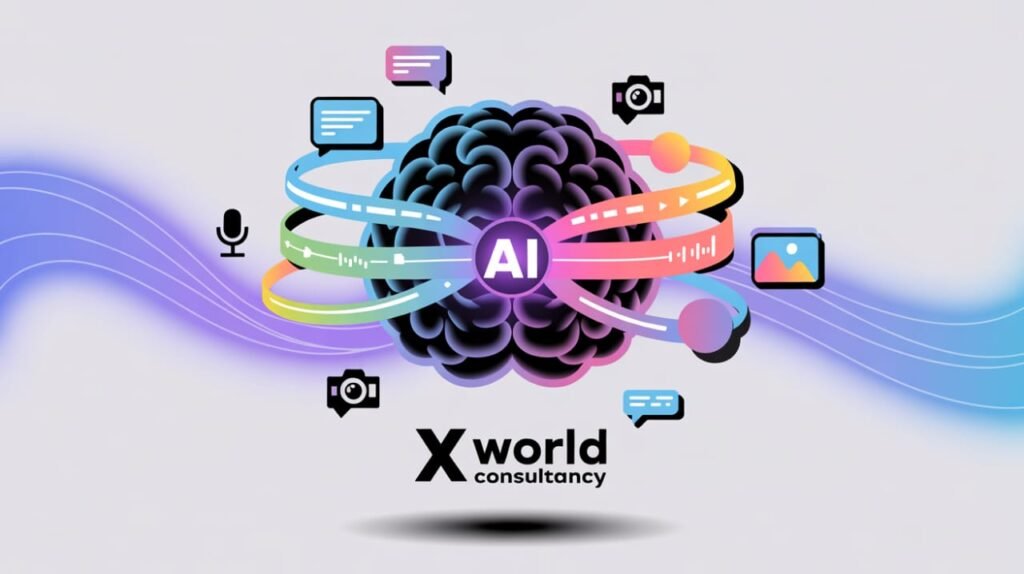
Artificial Intelligence has already changed the way businesses operate, create content, and interact with customers. While text-based generative AI captured early attention, the next major transformation is happening with multimodal generative AI. This new class of systems combines different types of data such as text, images, audio, and video into a unified model. As a result, machines can now “see, hear, read, and speak” in ways that were impossible just a few years ago.
In this blog, we will explore what multimodal generative AI is, why it matters, how it works, its business applications, challenges, and future outlook. Additionally, we will break down technical concepts into simple language so that even non-experts can understand the impact. Transition words will guide you through every section, making the reading experience smooth and engaging.
What is Multimodal Generative AI?
Traditionally, artificial intelligence systems specialized in one form of data. For example, natural language models handled text, computer vision models worked with images, and speech recognition focused on audio. However, human intelligence does not operate in isolation. We read words, interpret visuals, process sounds, and combine everything into a single understanding.
Similarly, multimodal generative AI refers to AI models that can process and generate outputs across multiple data formats simultaneously. In other words, it is about creating unified systems that understand text, visuals, and sounds together instead of separately. Consequently, these models can write descriptions for images, generate realistic voices from text, create videos from scripts, and even design interactive experiences.
How Does Multimodal Generative AI Work?
To truly understand the power of multimodal systems, it is necessary to explore how they function. At the core, these systems rely on large neural networks trained on datasets that combine various modalities. Instead of training separate models for text and images, engineers build architectures that learn patterns across both.
For instance, when a model is shown an image of a cat and the caption “a fluffy white cat sitting on a sofa,” it learns the relationship between visual pixels and descriptive text. Over time, it can generate new captions for unseen images or even create new images from written prompts. Similarly, by combining text and audio data, it can learn how written words should sound when spoken aloud.
Therefore, the key lies in alignment. These models build shared representations, meaning the internal mathematical patterns are mapped in such a way that text, image, and audio can interact seamlessly. Consequently, the system develops the ability to generate outputs in one format based on inputs from another.
Key Features of Multimodal Generative AI
- Cross-modal understanding – The ability to connect text, image, and audio in meaningful ways.
- Content generation – Producing images, videos, and sound based on textual or visual prompts.
- Contextual reasoning – Using multiple input sources to give more accurate and relevant responses.
- Personalization – Creating content that feels human-like and tailored to individual users.
- Interactivity – Building applications where users can engage with different media formats simultaneously.
Because of these features, businesses and industries are beginning to adopt multimodal generative AI at a rapid pace.
Business Applications of Multimodal Generative AI
- Marketing and Content Creation
Marketers can now create entire campaigns using a single AI platform. For example, a business can provide a text prompt such as “create a futuristic ad for an electric car,” and the AI can generate a video script, corresponding visuals, and even a background soundtrack. Consequently, the time and cost of content production are reduced significantly.
- Healthcare and Medical Imaging
Doctors already use AI for diagnostic purposes, but multimodal systems can combine medical imaging with patient notes. As a result, doctors receive more accurate insights because the model correlates text data with image scans. Furthermore, it can generate detailed reports that save time and improve patient care.
- Education and Training
Learning experiences are becoming more interactive with multimodal AI. Imagine a student typing a question about the solar system, receiving a written explanation, an interactive 3D model, and an audio narration all at once. This integrated approach ensures better retention and engagement.
- Customer Service
Chatbots powered by multimodal generative AI can analyze text complaints, recognize customer emotions in voice calls, and even interpret screenshots shared by users. Therefore, customer support becomes more natural, personalized, and efficient.
- Entertainment and Media
From film production to gaming, multimodal AI is revolutionizing creativity. Game developers can design characters by describing them in words, while filmmakers can use AI to storyboard scenes with both images and narration. Consequently, creative industries benefit from faster workflows and lower production barriers.
Advantages of Multimodal Generative AI
Enhanced creativity – It enables humans to expand creative boundaries by providing new ideas and assets.
Efficiency – It reduces the time needed to create or process multimedia content.
Accessibility – It helps people with disabilities by turning text into speech, images into descriptions, or video into summaries.
Scalability – It allows businesses to reach more audiences with personalized content across different channels.
Since these advantages directly impact industries, organizations are quickly investing in research and adoption.
Challenges and Concerns
Even though the technology is promising, challenges must be addressed.
- Data quality and bias – Since models are trained on large datasets, poor data quality or hidden biases can lead to unfair or inaccurate results.
- Computational cost – Training multimodal models requires enormous resources, which limits accessibility for small companies.
- Ethical issues – The ability to generate fake but realistic videos and voices raises concerns about misinformation and misuse.
- Privacy risks – Using multimodal systems that process sensitive data can threaten user privacy if not handled responsibly.
Therefore, balancing innovation with ethics is critical. Businesses need governance frameworks to ensure responsible use.
The Future of Multimodal Generative AI
Looking ahead, the next decade will witness even more integration. Instead of handling just text, image, and audio, future models will incorporate sensory data such as touch or real-time environmental signals. Additionally, on-device AI will allow multimodal systems to run directly on smartphones, reducing dependency on cloud infrastructure.
Another future trend involves agentic AI—autonomous agents that use multimodal inputs to make decisions, solve problems, and interact with humans in natural ways. Consequently, the line between human creativity and machine intelligence will continue to blur.
At the same time, regulatory frameworks will grow stronger. Governments and organizations are already working on AI regulations to ensure fairness, safety, and accountability. Thus, businesses that adopt multimodal AI responsibly will gain trust and competitive advantage.
How Businesses Can Prepare
For companies looking to integrate multimodal generative AI, here are practical steps:
- Assess needs and use cases – Identify where multimodal AI can bring the highest value.
- Invest in infrastructure – Ensure enough computing power and data storage for advanced models.
- Collaborate with experts – Work with AI consultants and researchers to avoid common pitfalls.
- Start small, scale later – Launch pilot projects before expanding to large deployments.
- Implement ethical safeguards – Build policies to prevent bias, misuse, and privacy violations.
By following these steps, organizations can unlock the full potential of multimodal systems while minimizing risks.
Conclusion
Multimodal generative AI represents one of the most exciting frontiers in artificial intelligence. Unlike traditional systems that focus on single data types, these advanced models integrate text, images, audio, and video into a unified intelligence. As a result, they create new opportunities for marketing, healthcare, education, customer service, and entertainment.
Nevertheless, challenges such as data bias, ethical risks, and high resource requirements cannot be ignored. Therefore, businesses must adopt the technology responsibly while preparing for future regulations. With the right balance between innovation and governance, multimodal generative AI will shape the future of digital transformation.
Ultimately, the companies that embrace this shift today will lead tomorrow’s marketplace with creativity, efficiency, and trust.
Buy Now : https://xworldconsultancy.in/courses/ai-tools-mastery-21-tools-to-earn/
Subscribe Now : https://youtube.com/@xworldconsultancy
Follow Us On Instagram : https://www.instagram.com/xworldconsultancy
Follow Us On X : https://x.com/xwconsultancy

Founder of X World Consultancy | Helping India grow with AI, Digital Skills & Career Transformation. 🚀
📍 Based in Haryana | 🇮🇳 Made for Bharat
🌐 Visit: https://xworldconsultancy.in
📩 support@xworldconsultancy.com